Every successful landscape project begins beneath the surface. Whether you’re preparing a building site in Park City, clearing land for development in Salt Lake City, or trenching for utilities across the Wasatch Back, professional excavation landscaping transforms raw terrain into buildable, functional space. At Prime Landscaping and Snow Removal LLC, our excavation landscaping services in Utah combine heavy equipment expertise with landscape sensibility, ensuring every dig, grade, and cut serves both structural requirements and long-term environmental health. With 30+ years of combined experience navigating Utah’s rocky mountain soils, expansive clays, and dramatic elevation changes, we deliver precise earthwork that sets the foundation for lasting landscape success.
Excavation Landscaping Service Areas
Prime Landscaping proudly provides excavation services throughout Utah:
- Park City, UT
- Salt Lake City, UT
- Cottonwood Heights, UT
- Sandy, UT
- White City, UT
- Kamas, UT
- Heber City, UT
- Midway, UT
Why Excavation Landscaping Matters in Utah
Utah’s diverse geology creates unique excavation challenges that demand specialized knowledge and equipment. From the granite bedrock of Park City’s mountains to the clay-heavy valley soils of Salt Lake City and the alluvial deposits of the Wasatch Back, every site presents distinct conditions affecting how earth must be moved, shaped, and stabilized.
The excavation specialists at Prime Landscaping understand that Utah earthwork requires:
- Rock and bedrock management – Park City’s mountainous terrain often requires blasting, hammering, or specialized cutting equipment to reach proper depths
- Expansive clay accommodation – Salt Lake City’s clay soils swell when wet and shrink when dry, requiring careful moisture management during excavation
- Frost-line awareness – All footings and utilities must extend below Utah’s 36-42 inch frost line to prevent freeze-thaw damage
- Erosion and sediment control – Managing disturbed soil during Utah’s intense thunderstorms and spring snowmelt to prevent environmental damage and regulatory violations
- Utility coordination – Safe excavation around Utah’s dense underground infrastructure of gas, electric, water, and communication lines
Our Excavation Landscaping Services
1. Site Preparation & Land Clearing
The critical first step transforming raw land into buildable space. Our site preparation in Park City and Salt Lake City includes:
- Vegetation removal – Clearing trees, shrubs, and groundcover using proper techniques that preserve desirable specimens
- Debris and rock clearing – Removing construction debris, boulders, and surface obstacles
- Topsoil stripping and stockpiling – Preserving valuable organic layer for later reuse in planting areas
- Rough grading – Establishing initial contours and drainage patterns
- Access road construction – Building temporary or permanent construction and service access
- Demolition – Safe removal of existing structures, pavements, and old landscaping
2. Foundation & Structural Excavation
Precision digging for buildings, walls, and structural elements:
- Building pad excavation – Level, compacted surfaces ready for foundation construction
- Footing trenches – Exact-width, exact-depth trenches for concrete footings and stem walls
- Basement excavation – Full-depth digging for walkout and daylight basements on sloped lots
- Retaining wall foundations – Trenches and pads engineered for structural wall support
- Pool and spa excavation – Precision shaping for vinyl, fiberglass, and concrete pool shells
- Pier and caisson drilling – Deep holes for structural support in challenging soils
3. Utility Trenching
Safe, precise excavation for underground infrastructure:
- Irrigation trenching – Clean, consistent depths for main lines and lateral pipes
- Electrical and lighting trenches – Proper depth and bedding for low-voltage and line-voltage wiring
- Drainage trenches – Sloped excavations for French drains, catch basins, and storm systems
- Gas and water line trenches – Code-compliant depth and clearance for utility installation
- Communication and fiber trenches – Protective bedding for data and phone infrastructure
- Directional boring – Minimal-dig trenchless technology for sensitive areas
4. Grading & Earthwork
Sculpting terrain for drainage, usability, and aesthetics:
- Rough grading – Mass earth moving establishing site contours and drainage
- Finish grading – Precision surface preparation for lawns, plantings, and hardscape
- Cut and fill balance – Efficient onsite material management minimizing import and export
- Slope shaping – Creating stable, usable angles from steep terrain
- Pad building – Constructing elevated, compacted surfaces for structures on uneven ground
- Swale and berm construction – Shaping land for natural water management
5. Rock Excavation & Specialty Earthwork
Addressing Utah’s challenging subsurface conditions:
- Bedrock hammering – Hydraulic breakers and hoe rams fracturing rock for removal
- Blasting coordination – Licensed explosive contractors for deep rock removal
- Rock milling – Grinding surface rock to acceptable grades
- Soil stabilization – Lime, cement, and geogrid treatment improving poor soils
- Import and export hauling – Efficient material movement to and from site
- Compaction testing – Nuclear density verification achieving specified compaction rates
| Excavation Service | Park City / Mountain | Salt Lake City / Urban | Wasatch Back / Rural |
|---|---|---|---|
| Site Clearing | Tree removal, rock clearing, alpine preservation | Tight lot demolition, utility coordination, debris recycling | Large-scale clearing, pasture conversion, agricultural prep |
| Foundation Digging | Bedrock breaking, deep frost footings, slope stabilization | Clay management, utility-dense excavation, zero lot line | Extended footings, well coordination, remote access |
| Trenching | Deep burial for freeze, rocky subgrade, minimal restoration | Utility coordination, directional boring, permit compliance | Extended runs, gravity systems, agricultural scale |
| Grading | Steep slope cuts, bench terracing, snow storage areas | Precision laser leveling, stormwater retention, compact spaces | Large cuts and fills, road building, pond construction |
| Rock Work | Granite breaking, blasting coordination, deep drilling | Limited rock, soil import, vibration monitoring | Alluvial deposits, gravel extraction, riprap production |
Professional Excavation Process
Pre-Excavation Planning
Thorough preparation prevents costly surprises:
- Site survey and staking – Precise boundary, elevation, and feature marking
- Utility location – Blue Stakes coordination identifying all underground lines
- Soil testing – Borings and analysis revealing subsurface conditions
- Permit acquisition – Grading, excavation, and environmental permits
- Erosion control planning – Sediment barriers, silt fence, and drainage protection
- Equipment selection – Matching machinery to site conditions and access
Execution & Quality Control
Precision operation with continuous monitoring:
- GPS-guided excavation – Real-time grade verification within tenths of a foot
- Lift compaction – Soil placed and compacted in controlled layers
- Moisture management – Adding or removing water for optimal compaction
- Density testing – Nuclear gauge verification of 90-95% Proctor density
- As-built documentation – Recording actual conditions for future reference
- Daily progress reporting – Keeping clients informed of milestones and adjustments
Restoration & Completion
Returning site to functional condition:
- Topsoil respreading – Replacing preserved organic layer for planting
- Final grading – Smooth, properly pitched surfaces ready for next phase
- Erosion control installation – Seeding, mulching, or matting disturbed areas
- Debris removal – Complete site cleanup and hauling
- Utility backfill – Proper bedding and cover for installed lines
- Access restoration – Repairing or improving construction access routes
Excavation Landscaping by Utah Location
Park City & Summit County
Mountain excavation demands specialized equipment and techniques:
- Bedrock prevalence – Hydraulic hammers, rock saws, and blasting for granite and quartzite
- Steep slope access – Mini-excavators and track loaders on challenging grades
- Alpine preservation – Protecting native vegetation and sensitive ecosystems
- Deep frost footings – 42-inch minimum depths for all structural work
- Snow storage planning – Designing plow pile areas that don’t damage structures
- HOA coordination – Meeting community timing and access requirements
Salt Lake City & Wasatch Front
Urban excavation navigates tight spaces and dense infrastructure:
- Zero lot line work – Operating within inches of property boundaries
- Utility-dense environments – Careful excavation around gas, electric, and fiber networks
- Clay soil management – Moisture control preventing sticky, unworkable conditions
- Dust and noise mitigation – Meeting municipal requirements for urban work
- Stormwater compliance – Sediment control meeting SLC discharge regulations
- Recycling coordination – Diverting concrete and asphalt from landfill
Heber Valley & Wasatch Back
Rural excavation addresses agricultural scale and natural conditions:
- Large-scale land clearing – Converting pasture and range for development
- Alluvial soil management – Working with gravelly, well-drained deposits
- Remote site logistics – Equipment mobilization and material hauling
- Agricultural coordination – Working around livestock, irrigation, and crop cycles
- Pond and reservoir excavation – Water feature construction for irrigation and recreation
- Road and driveway building – Gravel base preparation for rural access
Seasonal Excavation Considerations in Utah
Spring (April – May)
Primary excavation season with optimal conditions:
- Thawed, workable soils – Ground moisture ideal for compaction
- Drainage verification – Spring runoff revealing actual water patterns
- Construction readiness – Completing prep for summer building season
- Erosion vigilance – Managing snowmelt and rain on disturbed sites
Summer (June – August)
Possible with moisture and heat management:
- Dry soil advantages – Easier digging in properly dried clay
- Irrigation coordination – Protecting existing landscape during work
- Heat safety protocols – Crew rotation and hydration management
- Storm preparedness – Quick erosion control after intense thunderstorms
Fall (September – October)
Excellent timing for winter readiness:
- Stable soil conditions – Dry, compactable before freeze
- Drainage testing – Fall rains verifying grades and systems
- Spring preparation – Completing prep for early season starts
- Reduced erosion risk – Less intense rainfall than summer
Winter (November – March)
Limited but possible for specific applications:
- Frozen ground excavation – Possible with rippers and specialized equipment
- Planning and permitting – Securing approvals for spring start
- Equipment maintenance – Preparing fleet for busy season
- Emergency response – Addressing drainage failures and structural issues
Frequently Asked Questions About Excavation in Utah
How long does excavation landscaping take in Utah?
Excavation timelines in Utah depend on project scope, site conditions, and weather. Small residential site clearing and grading typically completes in 1-3 days. Standard foundation digging for a home requires 3-7 days. Utility trenching for residential irrigation and drainage runs 1-3 days depending on linear footage and complexity. Large commercial site preparation may take 2-4 weeks. Park City projects with bedrock breaking add significant time, rock excavation can extend timelines by 50-100% compared to soil-only work. Weather significantly impacts schedules; spring snowmelt delays mountain projects, while summer thunderstorms halt exposed earthwork. Prime Landscaping provides detailed timelines during consultation, building in weather contingencies and maintaining open communication about progress.
Do I need permits for excavation work in Utah?
Most excavation work in Utah requires permits, though requirements vary by location and scope. Salt Lake City requires grading permits for cuts or fills exceeding 2 feet, any work changing drainage patterns, or excavation over 500 cubic yards. Park City and Summit County have similar thresholds with additional environmental review for work near waterways or on slopes over 25%. Utility trenching typically does not require permits when performed on private property but must comply with Blue Stakes notification and utility clearance requirements. Foundation excavation requires building permits as part of the construction process. Prime Landscaping handles all permit research, application preparation, and inspection coordination as part of our comprehensive service. We maintain relationships with municipal planners across Utah’s Wasatch Front and Back, ensuring compliant, timely approvals.
How do you protect existing landscaping during excavation?
Prime Landscaping employs multiple strategies to protect existing landscape during excavation. Pre-construction documentation includes detailed photography and marking of trees, shrubs, and features to preserve. Protective fencing creates physical barriers around critical root zones and specimen plantings. We use plywood sheeting over lawns and paving to distribute equipment weight and prevent rutting. Hand digging replaces mechanical excavation within sensitive areas. Directional boring eliminates trenching through established plantings. For Park City’s mature mountain landscapes and Salt Lake City’s established gardens, we coordinate access routes to minimize traffic across valuable turf. Post-excavation restoration includes soil decompaction, topdressing, and seeding or sod replacement for any disturbed areas. Our goal is completing necessary earthwork while preserving the landscape elements you value.
What equipment do you use for excavation landscaping?
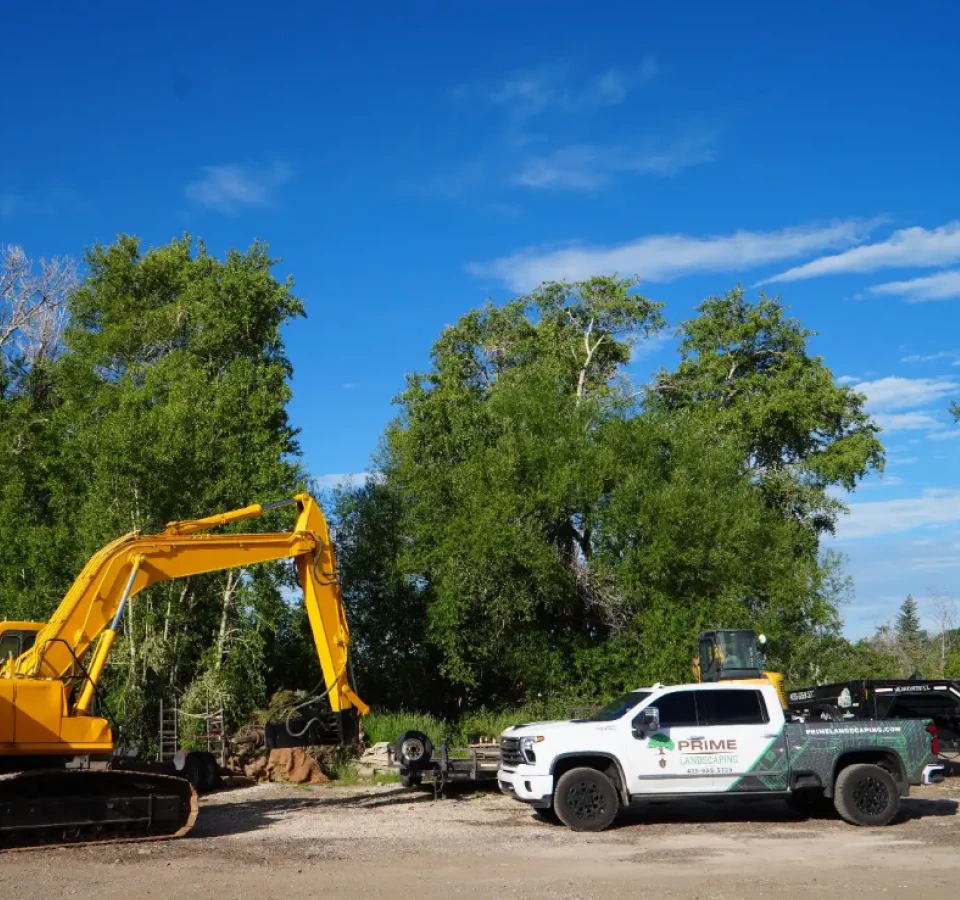
Prime Landscaping maintains a comprehensive fleet of excavation equipment matched to Utah’s diverse conditions. For major earthwork: CAT 320 and 336 excavators, CAT D5 and D6 dozers, and 14-foot motor graders. For tight-access residential work: Kubota KX040 and Bobcat E85 mini-excavators, skid steers with multiple attachments, and compact track loaders. For specialized applications: hydraulic breakers and hoe rams for rock, vibratory plate compactors and sheepsfoot rollers for compaction, trenchers for utility installation, and dump trucks for material hauling. We also employ GPS machine control systems for precision grading within tenths of a foot. All equipment is rubber-tracked or equipped with turf tires when working on established landscapes to minimize surface damage. For remote Wasatch Back properties, we coordinate equipment mobilization and staging to maximize efficiency.
How do you handle rock and bedrock during excavation?
Rock and bedrock management is a Prime Landscaping specialty, particularly for Park City and mountain properties where granite, quartzite, and limestone are common. Our approach begins with pre-construction geotechnical investigation to understand rock depth, hardness, and fracture patterns. For shallow or fractured rock, we use hydraulic breakers and hoe rams mounted on excavators to fracture material into removable pieces. For deep or massive bedrock, we coordinate licensed blasting contractors who drill and explosively fracture rock for excavation. In sensitive areas where blasting is prohibited, we employ rock saws and wire sawing for precise cutting. All rock removal includes proper disposal or onsite repurposing as riprap, fill, or decorative boulders. We also adjust foundation designs when bedrock is encountered unexpectedly, working with engineers to design pinned or anchored foundations that use rock as support rather than requiring complete removal.
What happens to excavated soil and rock?
Prime Landscaping prioritizes responsible material management for all excavated soil and rock. Our first preference is onsite reuse, reusing clean fill for grading, topsoil for planting areas, and rock for riprap, retaining walls, or decorative features. When onsite reuse isn’t possible, we sort materials for recycling: clean concrete and asphalt go to crushing facilities for base material production; organic topsoil goes to composting operations; and rock goes to quarry reclamation or landscape supply yards. Only contaminated or unsuitable materials go to landfill, and we minimize this through careful segregation. For large projects, we coordinate with local farms and developments that need fill material, creating beneficial reuse partnerships. This approach reduces project costs, minimizes environmental impact, and supports local material cycling. We provide documentation of material destinations for projects requiring waste tracking and sustainability reporting.
Why Choose Prime Landscaping for Excavation in Utah?
Since 2018, Prime Landscaping and Snow Removal LLC has completed hundreds of excavation projects across Utah’s most challenging terrain. Our excavation expertise includes:
- 30+ years of combined earthwork experience with Utah’s unique rock, clay, and mountain soils
- Licensed and insured operators with CDL certifications and safety training
- In-house equipment fleet – excavators, dozers, graders, and compactors ready for immediate deployment
- GPS precision technology – machine control systems achieving grading accuracy within 1/10th of a foot
- Elevation-specific knowledge – understanding Park City’s bedrock challenges versus Salt Lake City’s utility-dense environment
- Integrated service capability – excavation flowing seamlessly into design, hardscape, softscape, and irrigation